Why Underpainting Still Matters in Traditional Oil Painting
Walk into any museum housing the Old Masters and you’re standing in front of centuries of layered paint. Beneath the luminous skin of a Rembrandt portrait or a Caravaggio composition lies something most viewers never see — a carefully considered foundation that shaped everything painted above it. That foundation is the underpainting, and it remains one of the most purposeful techniques a traditional oil painter can use.
Yet in an age of fast art content and instant results, underpainting is sometimes dismissed as an unnecessary extra step. Why bother with a monochrome layer when you could dive straight into color? The answer, as any painter who has wrestled with a difficult composition will tell you, is that underpainting doesn’t slow the work down — it organizes it. This article explores what underpainting actually does, why it still matters, and how to approach it in your own oil painting practice.
What Is Underpainting, Exactly?
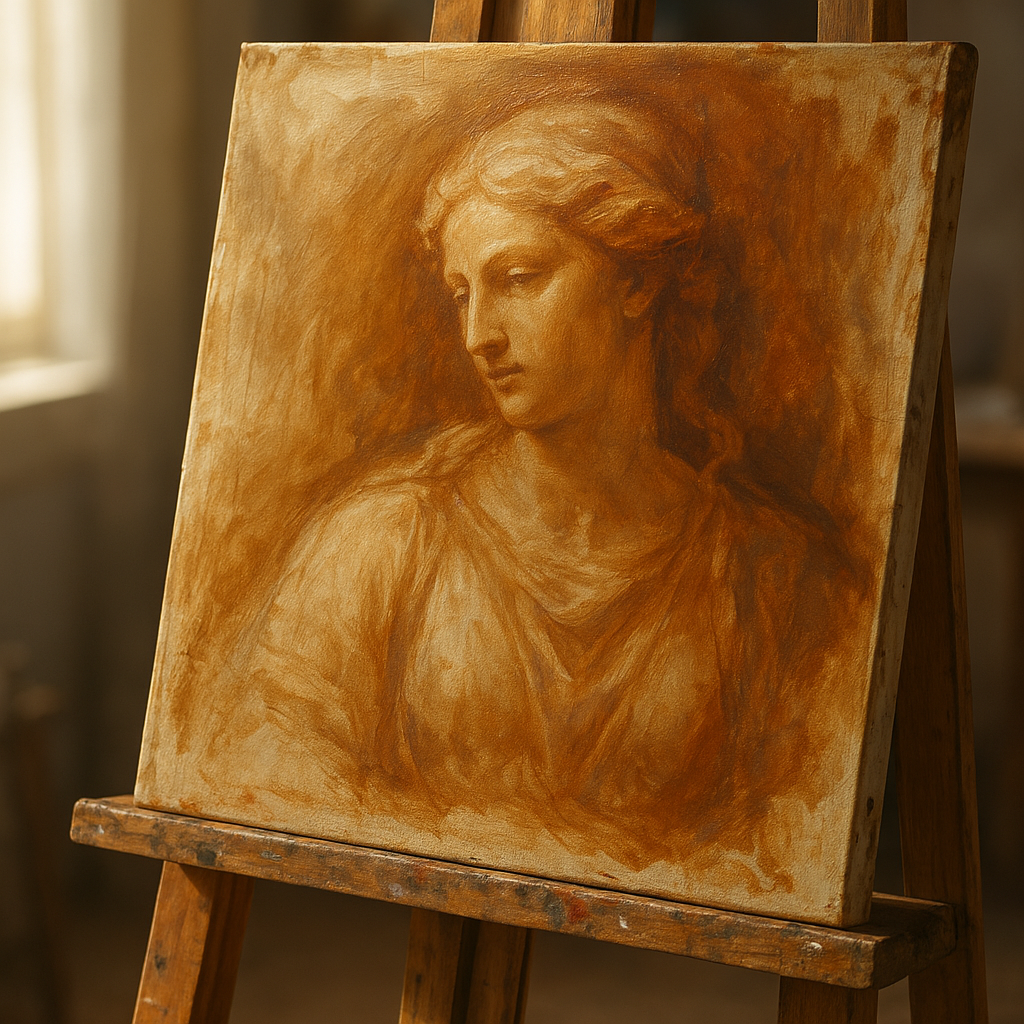
Underpainting is a preliminary layer of paint applied to a canvas before the final color layers are added. It’s typically executed in a single color (or limited palette), and its primary job is to establish the tonal structure — the lights and darks — of a composition before any chromatic complexity is introduced.
Think of it as building the skeleton before adding flesh. You’re not trying to create a finished painting at the underpainting stage; you’re mapping out where the light falls, where the shadows sit, and how the major shapes relate to one another. Once that tonal roadmap is in place, every subsequent layer of color has something meaningful to respond to.
The practice has roots going back to at least the 15th century. Flemish painters used a technique called verdaccio — an olive-green or grayish underpainting — particularly for flesh tones, which would later be glazed with warm colors to produce that remarkable translucency. Italian Renaissance painters favored a similar approach. Rembrandt’s use of earth-toned imprimatura layers is well documented in technical analyses of his work.
The Real Benefits of Underpainting in Oil Painting
The question “is underpainting really necessary?” comes up often among painters at every level. The honest answer is no — you can absolutely paint without one. But understanding what you give up by skipping it helps clarify why so many traditional painters continue to use it.
It Simplifies the Problem-Solving Process
Oil painting asks you to manage a lot simultaneously: composition, value, color temperature, edges, texture, and form. Trying to solve all of these at once, from the very first brushstroke, is cognitively demanding and often leads to muddy, overworked passages.
Underpainting lets you break the process into stages. In the first stage, you only need to think about value — light versus dark. Get the tonal structure right in monochrome, and the color stage becomes significantly more intuitive. You’re no longer asking “where does the shadow fall?” because you’ve already answered that. You’re free to focus entirely on color relationships.
It Improves Color Luminosity
One of the most visually striking reasons to underpainting is the effect it has on the light quality of the final painting. When thin, semi-transparent color glazes are laid over a dried underpainting, light passes through those upper layers, bounces off the lighter areas of the underpainting beneath, and travels back up to the viewer’s eye. The result is a depth and luminosity that physically can’t be achieved by mixing all your color on the palette and applying it in a single opaque layer.
This is the optical principle behind the glazing technique — and underpainting is its essential prerequisite. Without an established tonal layer beneath, there’s nothing for the glazed color to respond to. Understanding how to blend colors across layered surfaces becomes far more intuitive once a solid tonal foundation is in place.
It Prevents Early Mistakes from Becoming Permanent
Compositional problems caught at the underpainting stage are cheap to fix. A figure that’s slightly too large, a horizon line sitting awkwardly, a focal point that competes with another element — these issues are easy to correct in a thin monochrome layer. Catching them after you’ve spent hours building up color and texture is an entirely different situation.
It Creates Visual Unity
When an underpainting color is allowed to show through gaps and broken passages in the upper layers, it acts as a unifying tone across the entire canvas. Areas of the painting that might otherwise feel disconnected are subtly linked by that underlying color, lending the finished work a coherence that’s hard to achieve through other means.
Do Oil Paintings Need an Underpainting?
This is one of the most frequently asked questions by painters moving from acrylics or watercolor into oils. The straightforward answer is that oil paintings don’t require an underpainting — but many painters find that working without one makes the process harder, not easier.
Some contemporary realist painters work alla prima (wet-into-wet, completing a painting in a single session) and produce exceptional results without any preliminary layer. But this approach demands a high level of confidence in value and composition, because there’s no net beneath you. For painters who are still developing their eye for tonal relationships, or who are working on complex compositions, an underpainting is less of an optional extra and more of a genuine problem-solving tool.
If you’re regularly finding that your oil paintings feel flat, lack depth, or take too long to resolve, the absence of an underpainting could be a contributing factor worth addressing.
What Color Is Best for Underpainting?
The choice of underpainting color depends on the subject matter, the mood you’re after, and the color temperature of the final layers. There is no single correct answer, but there are well-established approaches worth understanding.
Burnt Umber
Arguably the most popular choice for traditional oil painters. Burnt umber is a warm, transparent earth color that dries relatively quickly, thins easily with mineral spirits, and provides a rich mid-tone from which both lights and darks can be developed. It’s particularly effective for portraits, figures, and warm interior scenes.
Raw Umber
Cooler and more neutral than burnt umber, raw umber suits landscapes and compositions where a warm bias in the underpainting might conflict with the intended color temperature of the final painting.
Verdaccio
The traditional green-gray mixture used by Renaissance painters, typically achieved by combining black, white, and yellow ochre (or a similar warm yellow). Verdaccio works especially well beneath skin tones because the cool greenish-gray creates a pleasing visual contrast with warm flesh colors glazed above it.
Blue or Complementary Colors
Some painters deliberately choose an underpainting color that’s complementary to the dominant hue of their subject. A blue or blue-gray underpainting beneath a predominantly warm landscape, for example, can make the warm oranges and yellows of the final painting feel more vibrant when they’re laid over it — the optical contrast between complementary colors creates a sense of energy and warmth that a same-temperature underpainting simply wouldn’t produce.
Underpainting vs No Underpainting: A Practical Comparison
For painters genuinely weighing whether to incorporate underpainting into their process, it helps to consider what each approach tends to produce.
- With underpainting: Tonal structure is established early, color application feels more decisive, glazing techniques become accessible, and compositional problems are caught before significant color work is invested.
- Without underpainting: The painting proceeds faster in the short term, but tonal decisions must be made simultaneously with color decisions, which can lead to overworking, muddy color, and flat light quality.
Neither approach is categorically superior — skilled painters exist in both camps. But for painters learning traditional oil painting techniques, the underpainting approach tends to produce more satisfying results earlier in the learning curve, because it teaches value separation as a foundational skill.
What Is the 80/20 Rule in Painting?
The 80/20 rule in painting is an informal principle suggesting that 80% of what makes a painting successful comes from 20% of the work — specifically, the early compositional and tonal decisions. This is precisely why underpainting matters in the broader context of oil painting craft.
The decisions made in the underpainting stage — where the lights sit, how the darks are distributed, how shapes are proportioned — have an outsized influence on everything that follows. Painters who invest thought and care into this foundational layer often find that the subsequent color stages come together more quickly and confidently. Painters who skip this step can spend far longer compensating for structural weaknesses during the color application stage.
Understanding the 80/20 rule also helps reframe how painters think about time investment. The underpainting stage can feel like a delay when you’re eager to get to color — but it’s more accurate to see it as concentrated effort that pays dividends throughout the rest of the process.

Using Acrylic for Underpainting
One practical note worth including: many oil painters use acrylic paint for their underpainting rather than oil. Because acrylic dries rapidly (often within an hour), an acrylic underpainting can be completed and dry to the touch far faster than an oil underpainting, allowing the painter to move into the oil color stages the same day.
This is a legitimate approach, provided the acrylic underpainting is completely dry before oil paint is applied over it. The general rule — fat over lean — applies here: acrylic under oil is considered acceptable because acrylic is more flexible when dry, and oil paint applied on top should not crack or delaminate. However, the reverse (oil under acrylic) should be avoided, as acrylic paint doesn’t adhere well to an oily surface.
Burnt umber acrylic thinned with water makes an accessible, affordable underpainting medium that many painters find extremely convenient, particularly when working in sessions with time constraints.
How to Approach Your First Underpainting
If you’ve never used underpainting before, the process is more straightforward than it might initially seem:
- Start with a toned canvas — a light wash of your chosen color thinned with mineral spirits (or water, if using acrylic).
- Sketch in your composition loosely, thinking only about shapes and placement at this stage.
- Identify your darkest darks and block them in with undiluted paint or thicker applications.
- Wipe out or lighten the areas that will become your highlights using a clean rag or a dry brush.
- Let the underpainting dry completely before applying any oil color on top.
Resist the urge to overfinish. The underpainting needs to establish tonal structure, not render every detail. Looseness at this stage is a virtue — you want the upper color layers to have something to build on, not something to obscure.
Why Traditional Techniques Still Have a Place in Contemporary Practice
There’s sometimes a perception that traditional techniques like underpainting belong only to the past — that contemporary painters working in oil have moved beyond such methodological constraints. But the enduring use of underpainting by representational painters, portrait artists, and still life specialists worldwide suggests otherwise.
Traditional techniques persist not out of nostalgia but because they solve real problems. Underpainting persists because it works — because it produces visual qualities (luminosity, depth, tonal unity) that alternative approaches struggle to replicate, and because it organizes the painting process in a way that reduces frustration and increases control.
Learning why the Old Masters painted the way they did isn’t about copying the past. It’s about understanding the logic behind methods that have been refined and tested across centuries of practice.
In Summary
Underpainting remains one of the most purposeful techniques available to oil painters working in a traditional idiom. It separates value from color, creates the conditions for luminous glazing, catches compositional problems early, and produces a unifying tone across the finished work. Whether executed in burnt umber oil paint or a quick acrylic wash, the underlying principle is the same: build the structure first, and everything layered above it becomes easier to resolve.
For painters looking to deepen their practice, revisiting underpainting — or trying it for the first time — is rarely a step backward. More often, it’s the change that makes everything else fall into place.